Fashion For Democracy: Design for Better Lives – AGORA & Gathering 12.12.2025
Fashion For Democracy: Design for Better Lives
Fashion can be a driver for positive change in almost any imaginable area – as well as for enhancing the spread of democratic values and practices. Our collaboration project Fashion For Democracy: Design for Better Lives investigates this specific area of transformation, uniting voices from around the globe. It is an official part of the World Design Capital® 2026, which presents a year-long program of events in the Frankfurt Main-Rhein region under the theme Design For Democracy: Atmospheres for Better Life. In this context, we highlight fashion’s unique cultural impact, alongside its systemic challenges. We invite our brilliant, diverse community into the conversation on how fashion might be a powerful agent of democracy.
AGORA und Gathering, live im Designhaus (Darmstadt) und weltweit online.
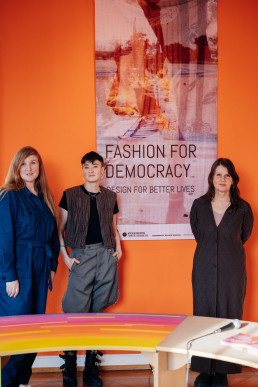
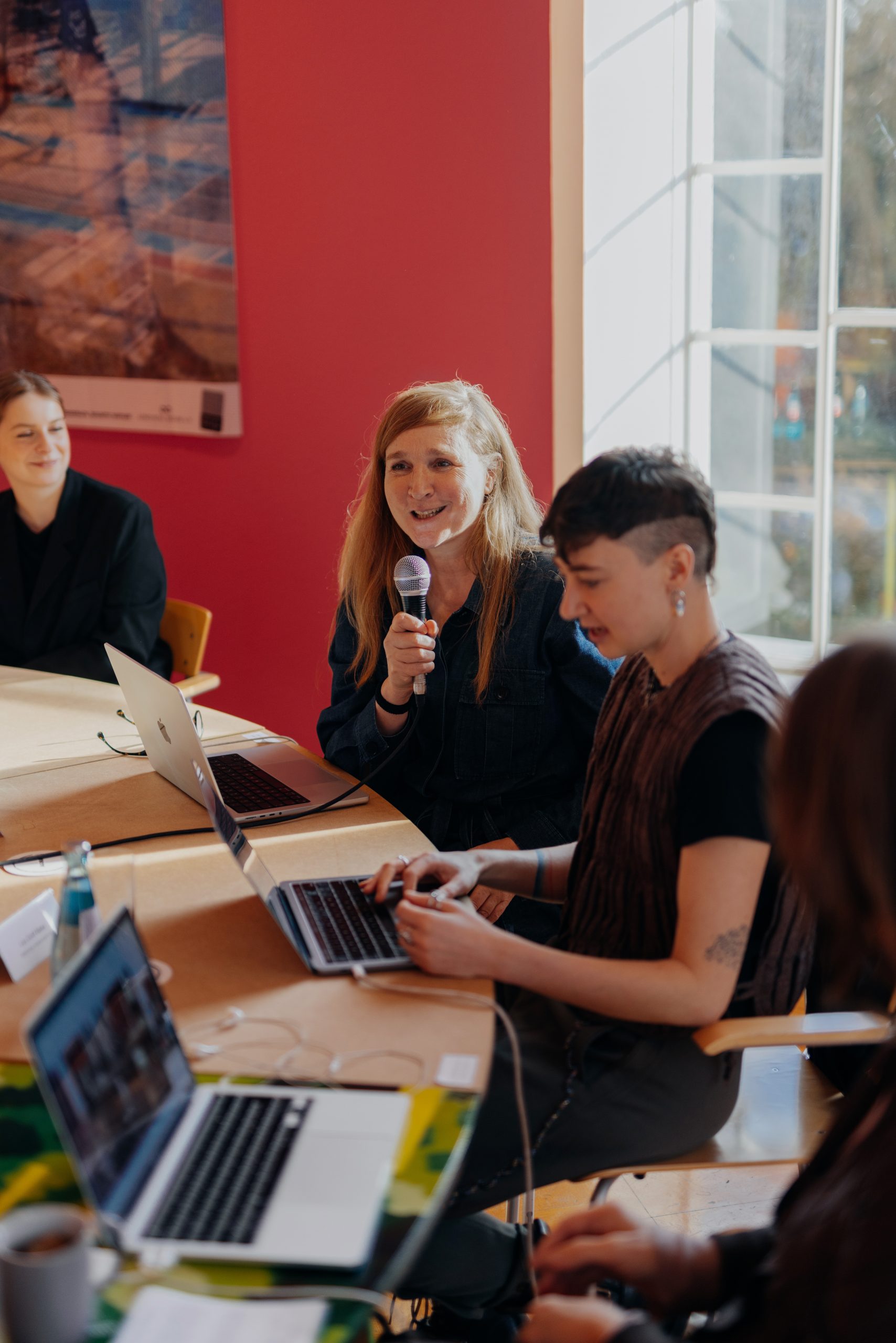
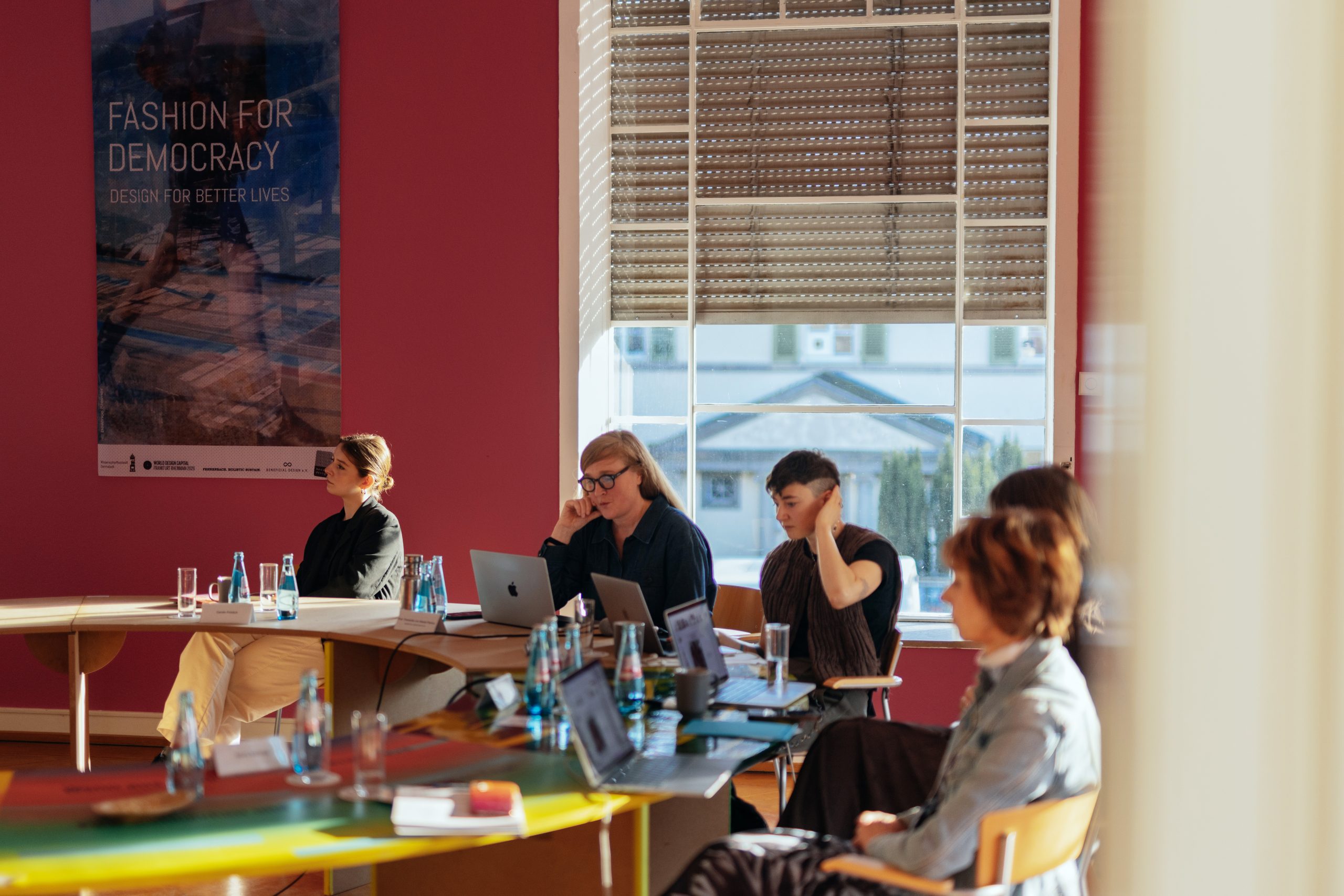
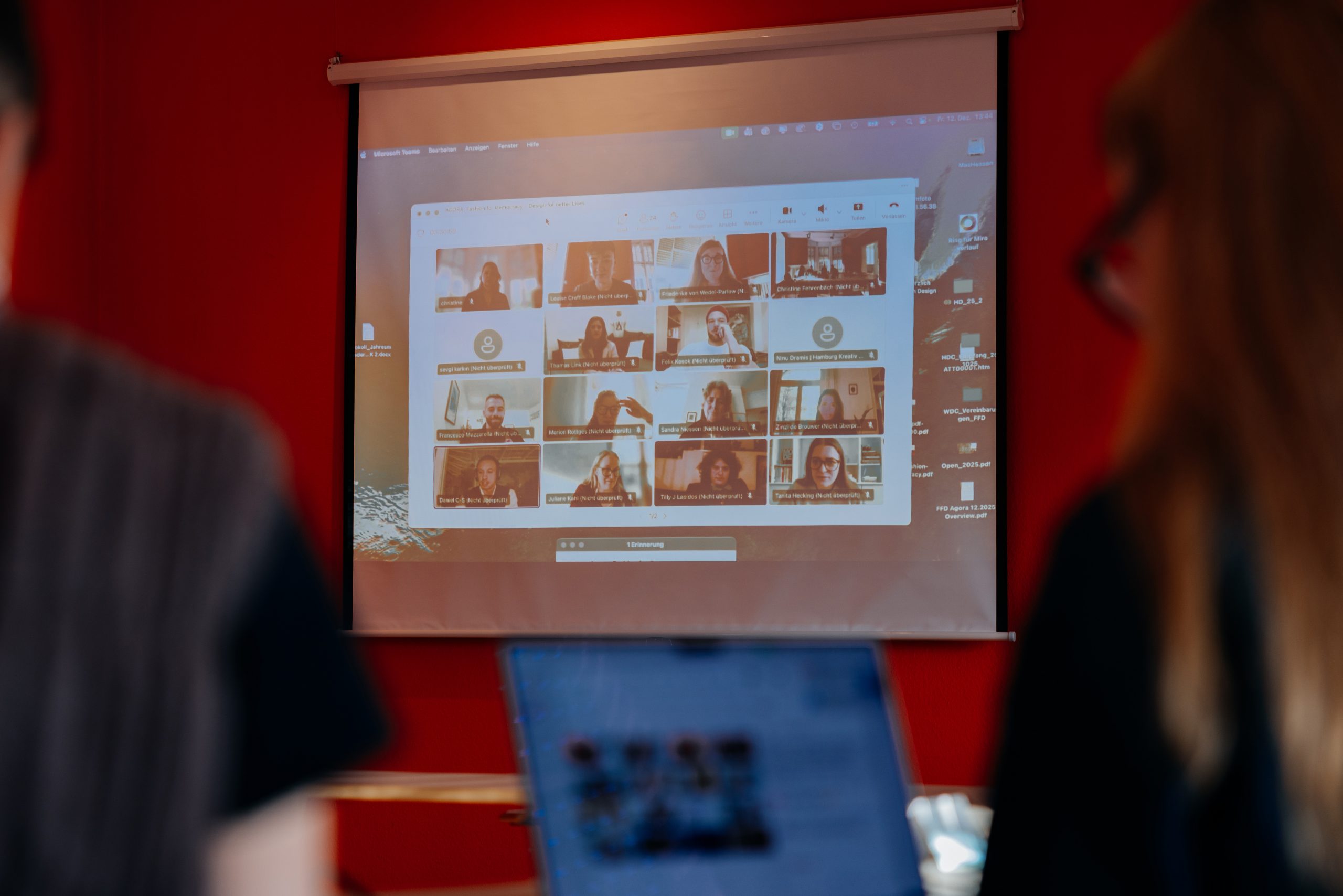
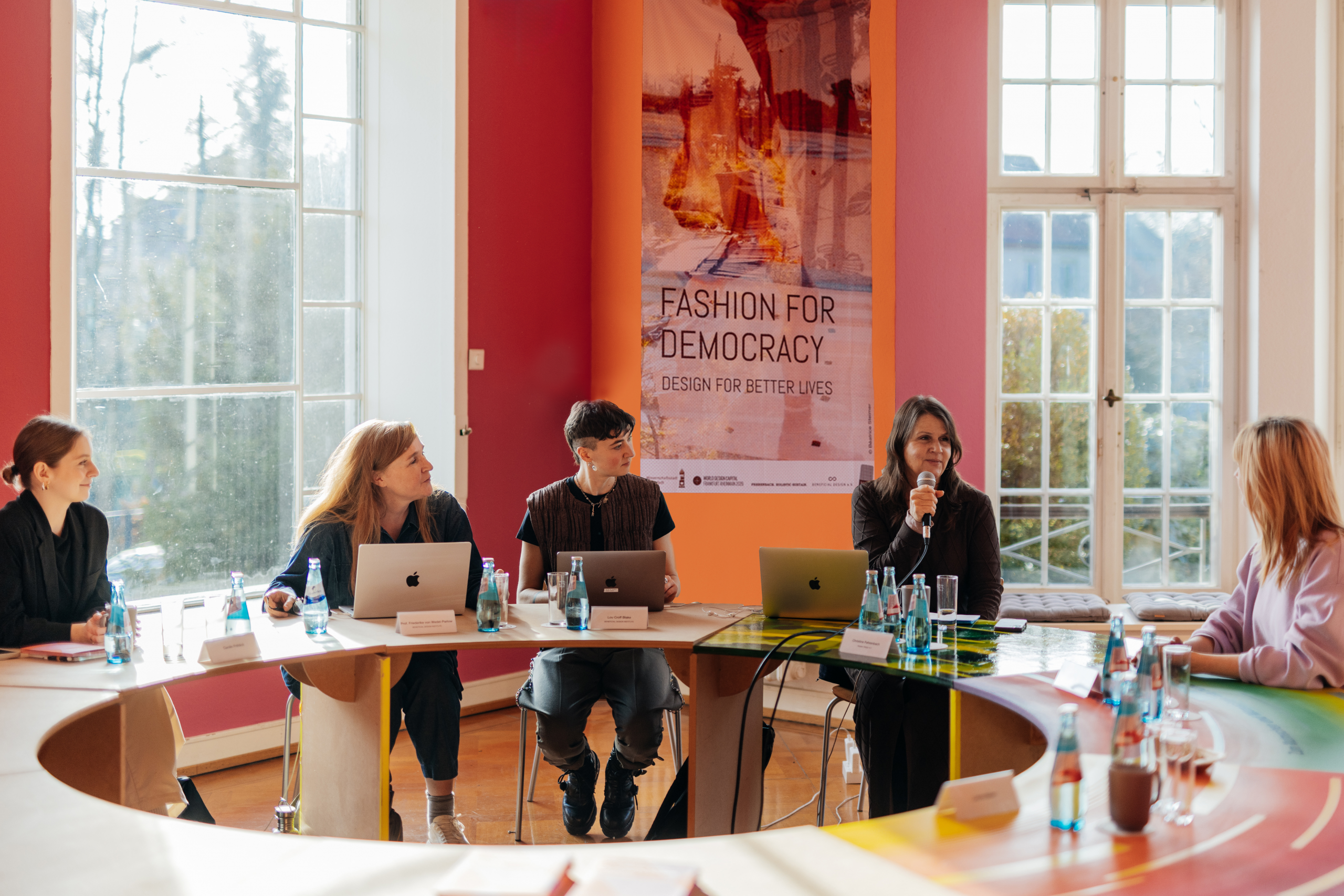
The Fashion For Democracy team hosted our first AGORA event on 12 December, 2025 at the historic Designhaus in Darmstadt, funded by Wissenschaftstadt Darmstadt. With project partner Hessen Design e.V. and Fehrenbach. Holistic Sustain, we welcomed two dozen international guests in a hybrid discussion and workshop, addressing core questions on fashion’s potential as an agent of democracy.
The AGORA’s key focus was on alternative fashion practices and systems. We define these ‘alternatives’ to mass fashion as the projects and initiatives (such as organizations, networks, and small businesses) that operate on grass-roots levels. They offer alternatives to civil society for how fashion can be experienced and wielded. These may include a broad range of formats, such as ethical, sustainable small brands, heritage craft projects, repair cafés, academic researchers, activist networks, NGO’s, political lobbies, and more. We investigate the extent to which alternative fashion may be situated within core principles of democracy, where decision-making and power structures might offer all involved a fair, equal stake and voice. Additionally, we posit that these alternatives must recognize their positioning and privilege regarding the global landscape of fashion.
Programm: Referenten, Workshop und Diskussion
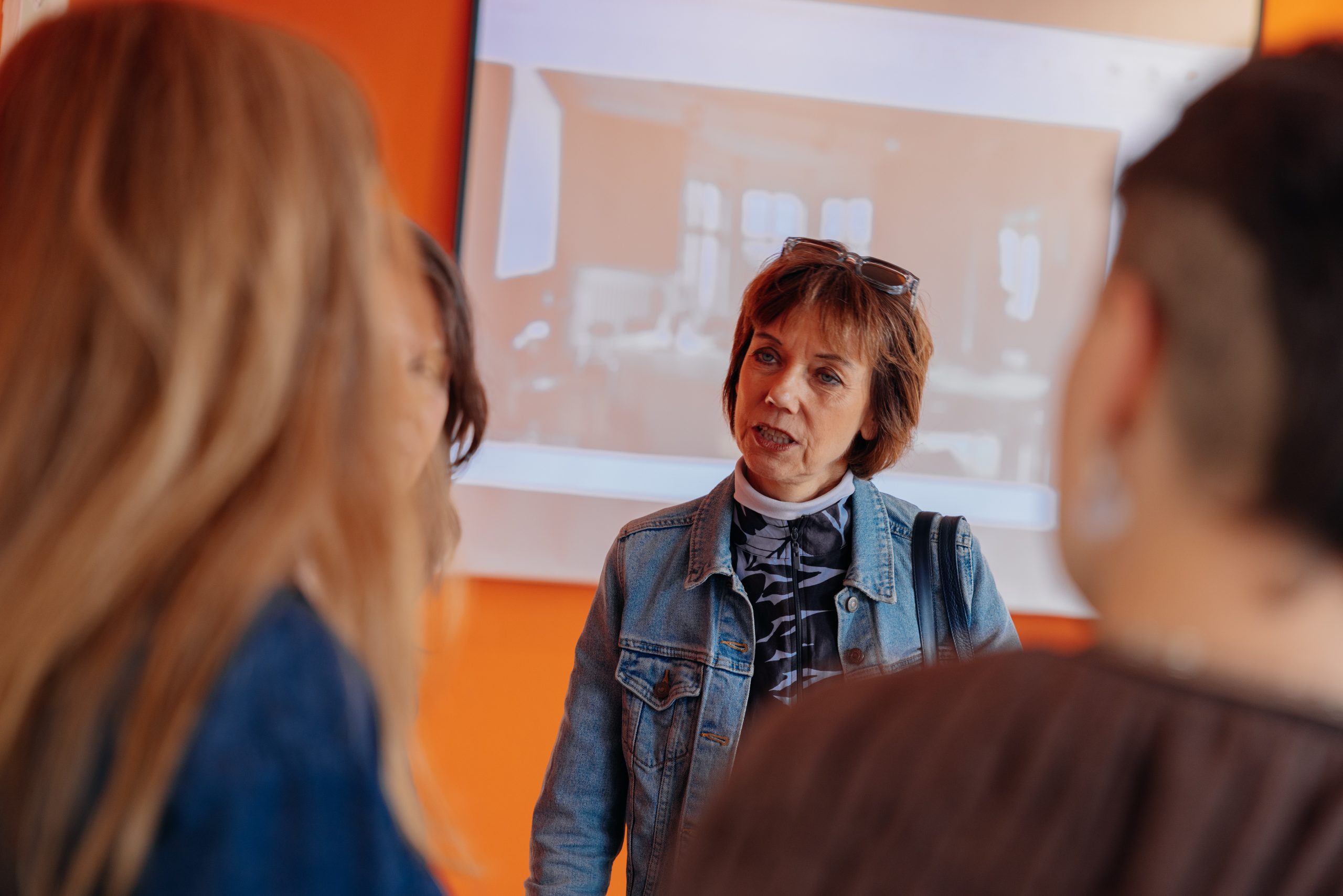
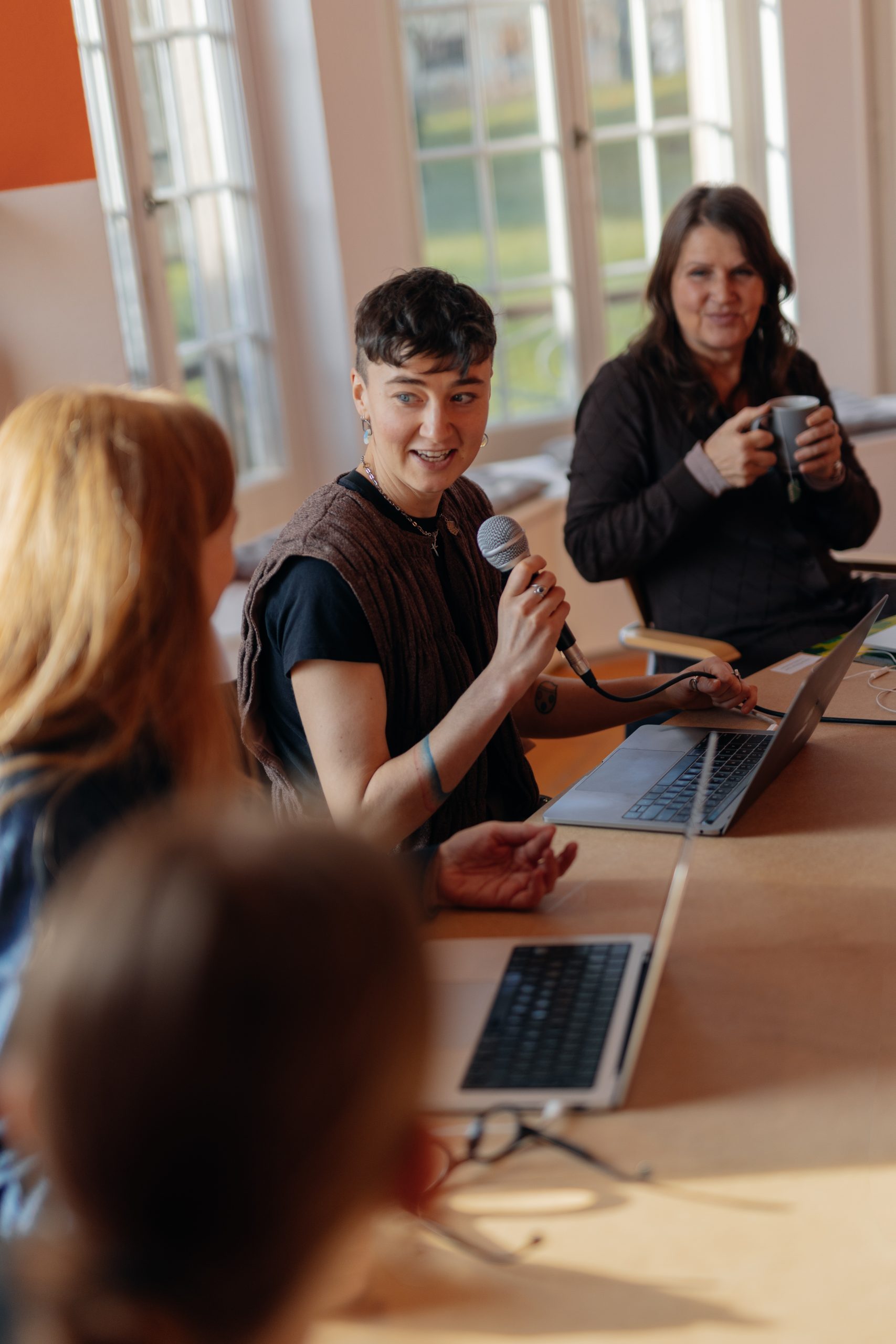
The afternoon kicked off with welcoming words from the Fashion For Democracy organizers Christine FehrenbachHessen Design e.V) und Prof. Friederike von Wedel-Parlow (Beneficial Design e.V.). The organizers expressed great excitement and gratitude for the attendance of those who joined for this seminal community gathering. After the welcome, participants each had a moment to introduce themselves, revealing the rich diversity of background and experience within the small group.
We received deeply inspiring impulse presentations from Felix Kosok (World Design Capital®), Dr. Francesco Mazzarella (London College of Fashion, UAL) und Zinzi de Brouwer (Studio PalhaEach guest speaker framed democracy and alternative practice in specific fashion contexts, ranging from design activism and semiotics, to community-led projects, to spreading decolonial ethos through intercultural exchange.
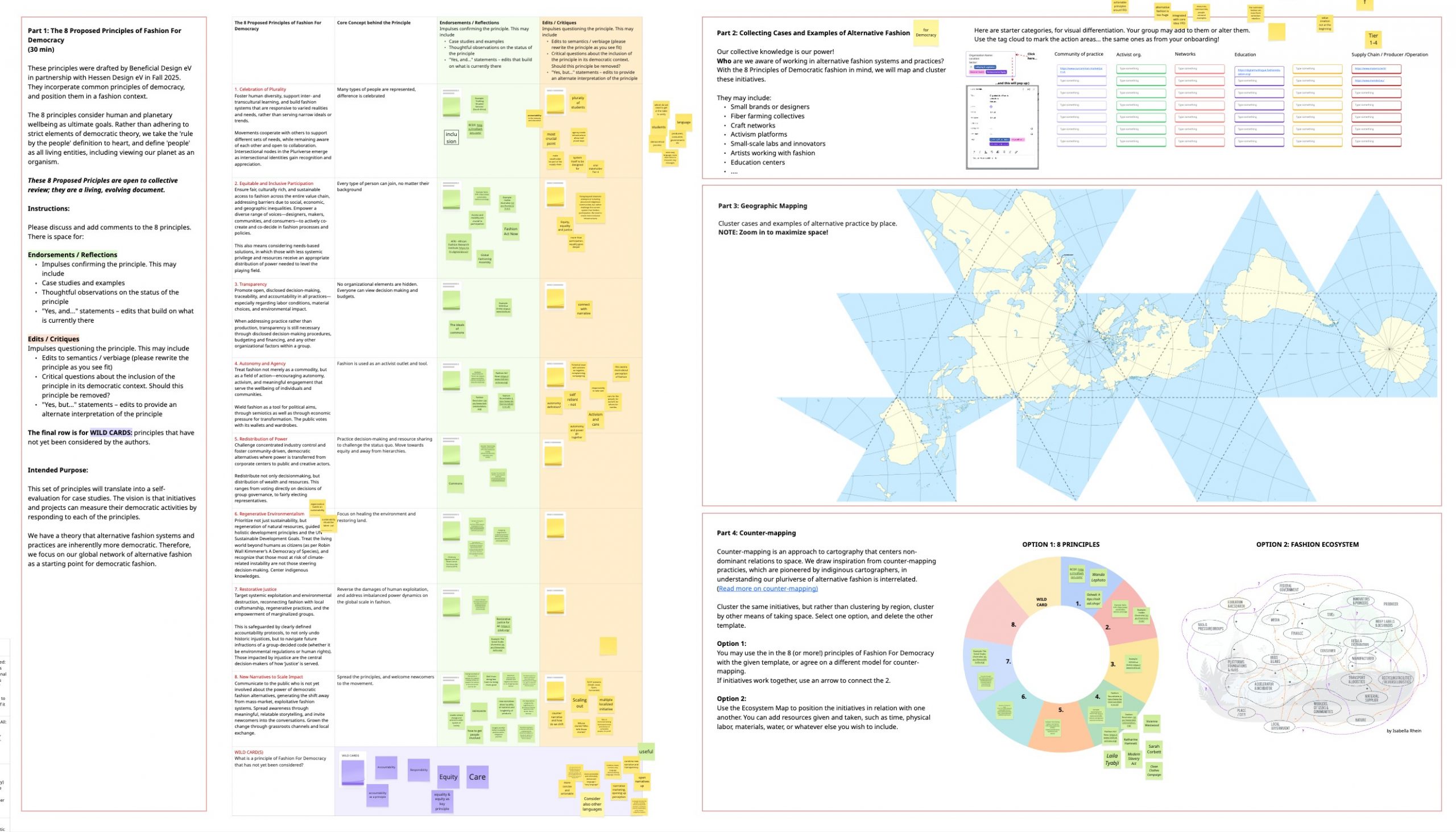
Lou Croff Blake (Beneficial Design e.V.) kicked off the workshop portion of the event, facilitating the group work on a shared Miro Board, where participants were invited into one of two discussion tracks.
The first track addressed the theme “Principles and Practices,” leading with a peer review exercise of the 8 Proposed Principles of Fashion For Democracy. These principles function as continually-evolving guidelines for working democratically in any fashion-related project or community. The review of the principles was followed by a group mapping exercise, which consisted of sharing and clustering alternative fashion projects and initiatives on a global scale. In addition to geographic mapping, participants rearranged the same projects and initiatives in a ‘counter-mapping’ exercise – organizing them by relation to one another, closing the physical distance between.
The second track focused on “Power and Pathways.” Groups began with an exercise to brainstorm resource redistribution, bringing materials, tools, spaces, and power from those who have surplus – in particular, from the mainstream fashion system – and delivering the resources to those who are working on the margins who could benefit. This rapid-fire brainstorming led to a second similar exercise, which flipped the equation in reverse: what would a future look like which alternative fashion is the norm and is well-resourced, with those at the margins having what they need? Tracing steps backwards, what would need to happen in order for us to arrive at such a future?
At the end of a rigorous hour of breakout sessions, participants reconvened to share their findings with the full group. With this extensive fresh input, a lively and thoughtful discussion finished the afternoon with equal measures of optimism, inspiration, and bold confrontation of fashion’s current social and environmental challenges.
Looking Ahead: Fashion for Democracy in 2026
The AGORA set the tone for a year of Fashion For Democracy – with a strong angle on human and ecological justice, an experience of immersive participation, and a strengthened community that spans many intersecting worlds. Fashion For Democracy is planning its next steps for a publication, events both online and in person at the World Design Capital®, and continued online community interaction. In the meantime, you can join our LinkedIn-Gruppe to connect with our community, hear about updates, and share your thoughts on Fashion For Democracy.